
Simple ways to foster independence, order and confidence in daily life.
Montessori at home is not a method to learn, a programme to follow, or equipment to buy. It's a way of looking at your child — understanding what they want to do by themselves — and adapting the environment so they can do it.
A predictable routine is a form of security. A consistent sequence — wash, dress, choose — builds confidence before the day even starts.
Offer two options, not twenty. A drawer at their height, sorted by category. The child chooses — and learns to manage a real decision.
A stool, a low mirror, a small towel they can reach. When the tools are at their scale, hygiene becomes something the child does — not something done to them.
A coat hook at the right height. A basket for shoes by the door. One clear place means one less reminder — for everyone.
Setting the table, carrying groceries, watering a plant. These are not chores — they are real contributions. Children need to feel genuinely useful.
Every object has a place. Every place is visible and accessible. Tidying up is not a punishment — it's the natural end of an activity.
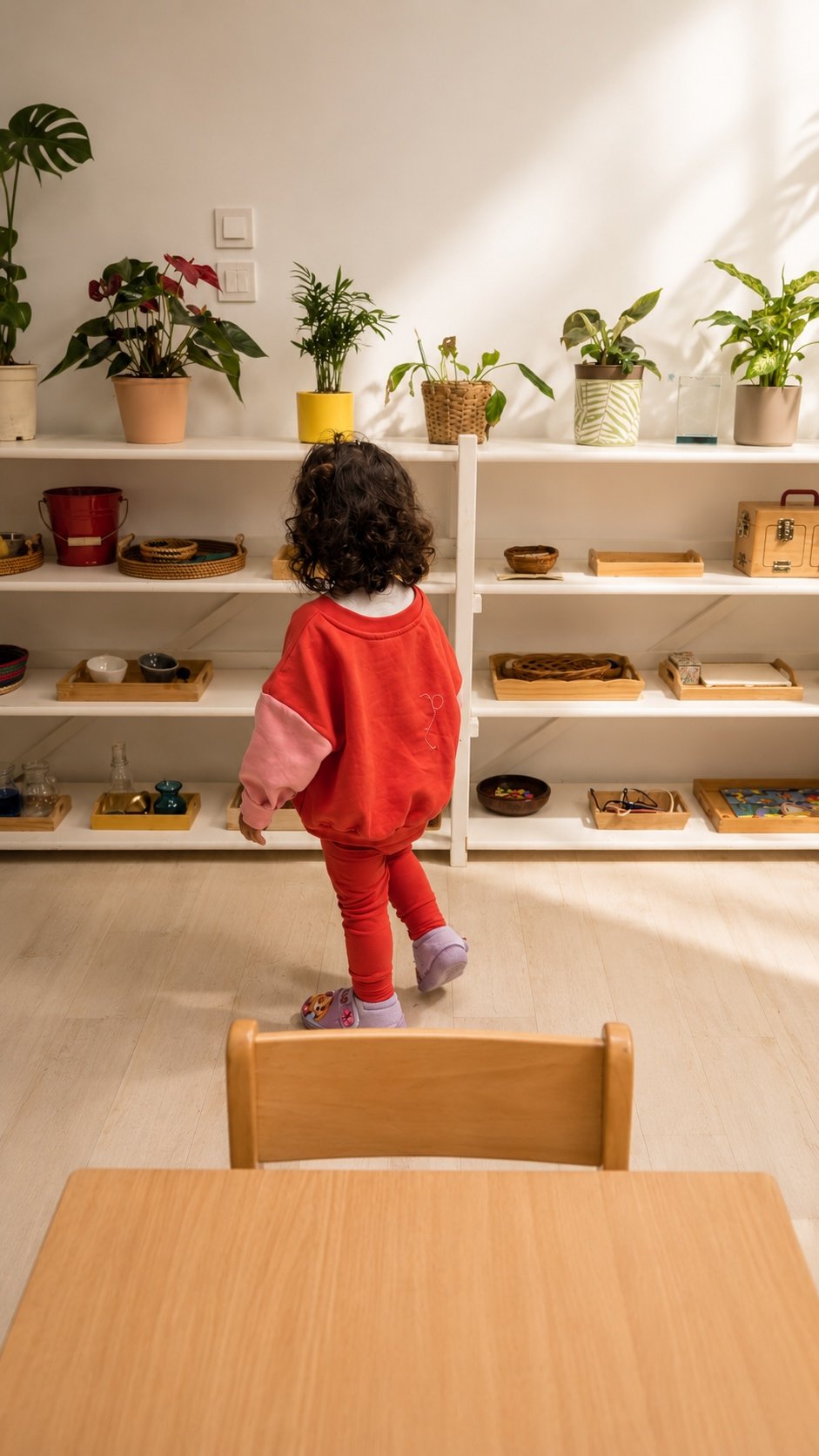
When a child can reach things independently, they stop needing you to fetch them.
Open shelves, baskets, clear boxes. What the child can see, they can choose.
Less choice is not deprivation. It is focus. It prevents the overwhelm that leads to chaos.
Always the same place for the same thing. Predictability builds confidence.
Calm environment, calm child. Not always — but far more often than we expect.
The reflex is to intervene immediately. But watching first changes everything. If a child struggles with a button for thirty seconds, they are not in distress — they are working. That tension is how concentration builds.
When you demonstrate a gesture, slow down. Fold the napkin, pour the water, tie the lace — slowly, clearly, silently. The child's eyes absorb what words cannot transmit.
A child who pours and repours, folds and refolds, is not being tiresome. They are mastering. Repetition is how a gesture becomes theirs. The goal is not to finish — it is to practise.
A real contribution — not a pretend one. A cloth they can actually use to wipe a surface. A plant they genuinely care for. Children know the difference between being useful and being humoured.
This is not a moral question. It is a developmental one. Young children need movement, real objects and human interaction to build their brains. Screens, when used early and often, compete with exactly those needs.
At this age, the brain grows through touch, movement, sound and face-to-face exchange. A screen cannot offer any of these. A saucepan, a pile of cushions, a ball of wool — these are all richer learning tools.
If screens are used, choose what, how long, and watch together. The best content remains simple, slow and interactive. No background TV. No screen as a pacifier. The child's attention is still forming — it is fragile and worth protecting.
The world is endlessly interesting for a child who has room to explore it. The question to ask before any screen time: is there something real — natural, tactile, relational — that could meet this need instead?
You don't need to change everything at once. One gesture, one space, one moment — that is already a real beginning.
What does he try repeatedly? What frustrates him because he can't manage it yet? That frustration is information — it points directly to where autonomy wants to grow.
One hook. One low shelf. One drawer they can reach. Start with where they spend most time. One accessible space is enough to begin.
Fewer toys, fewer options. Not as a punishment — as a gift. A clear space frees the child to focus. Put the rest away, rotate occasionally.
Choose one skill they're ready for. Demonstrate it once, silently, slowly. Then step back. Resist the urge to correct immediately.
Do not rush the conclusion. If the child wants to pour again, fold again, sweep again — let them. Mastery arrives through repetition, not instruction.
A single small change can already transform daily life. You don't need an ideal home, a complete set of Montessori furniture, or hours of time. You need one gesture — chosen well.
A hook, a tray for shoes, a small mirror. Ten minutes to install — and every morning becomes calmer.
A stool by the sink. A towel they can reach. A toothbrush holder at the right height. These are not renovations — they are small adjustments.
Fewer toys visible at once. A low shelf for books. The bed they can make themselves. One tidy room changes the tone of the whole day.
A stable chair, at the right height. A small place mat to mark their spot. The feeling of having a real, dignified place at the family table.
It is the coherence of training, practice and environment that makes the difference.
DiscoverCome visit. Our educators will show you the prepared environments and answer your questions.