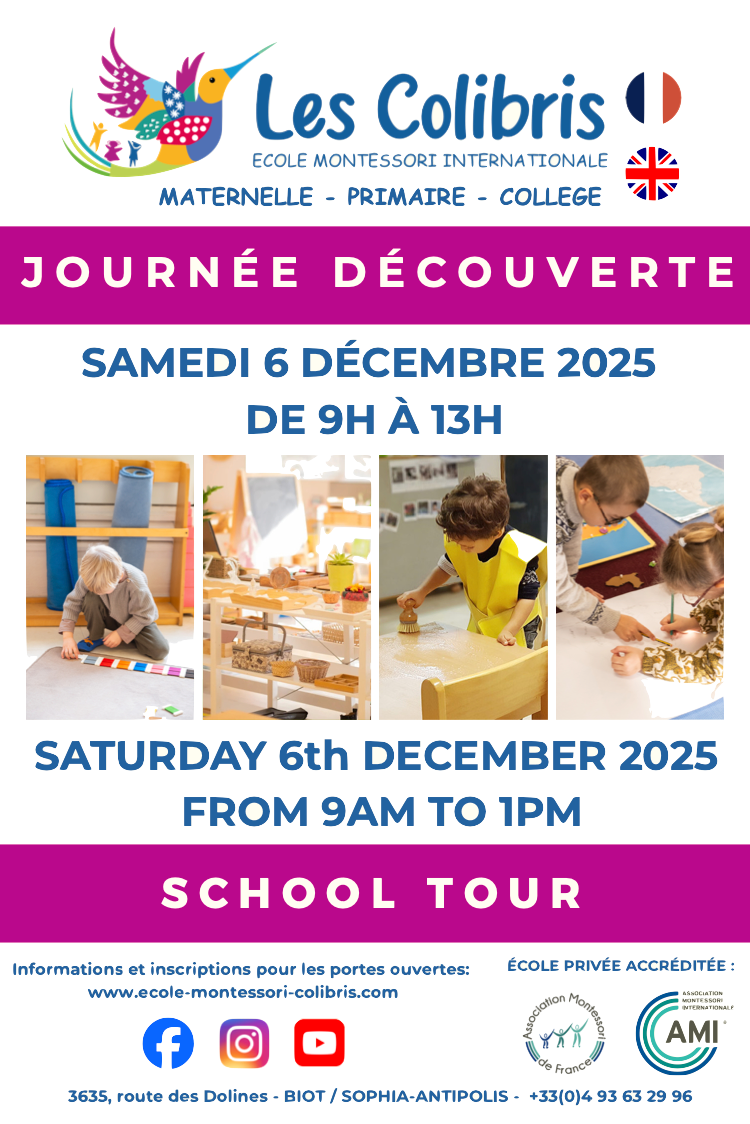
Les Colibris Montessori
Everything you need to know about our approach, our schools and the admissions process — clear, honest answers.
Dr. Steve J. Hughes, PhD, pediatric neuropsychologist — "Why should I choose a Montessori school for my child?"
Montessori education is a child-centred approach developed by Dr Maria Montessori in the early 20th century. It is based on three key principles: freedom of choice within a structured environment, multi-age groupings, and hands-on learning materials that progress from concrete to abstract. The educator's role is to observe, prepare the environment and offer individual presentations — not to teach from the front.
Yes. The Montessori method was originally developed for children with learning difficulties and has proven effective for all profiles. It naturally adapts to different paces, temperaments, and learning styles. There is no such thing as a "Montessori child": there is a child, and an environment designed to meet them where they are.
No. Montessori offers freedom within a clear structure. Rules exist and are deeply internalized rather than externally imposed. Children choose their work, but within a carefully prepared environment with clear boundaries. The structure is real; it is simply less visible from the outside.
Yes — and research consistently shows Montessori children adapt well to traditional systems. They are autonomous, capable of deep focus and intrinsically motivated. These qualities are assets in any educational context. Our graduates transition successfully to collège, lycée and higher education.
Our educators hold AMI (Association Montessori Internationale) or AMF (Association Montessori de France) certification — the gold standard in Montessori teacher training. The schools are registered with the French National Education authority (Éducation Nationale) and follow the national curriculum framework.
Our schools welcome children from 2 years old. The toddler community (2–3 years) is the entry point. Children can join at any age within the programme ranges — we assess readiness individually during the visit.
A visit is strongly recommended and is part of our standard process. It allows you to discover the environments in action, meet the team and ask your questions. It also helps us understand your child's context. Contact us to book your visit.
After your visit, we provide the full application file. It typically includes: identity documents, proof of address, health records (carnet de santé), recent photographs and a questionnaire about your child. The complete list is confirmed at the time of application.
We aim to respond within one week of receiving a complete application. Response times may vary depending on availability and time of year. We process applications on a first-come, first-served basis.
Yes, subject to availability. Mid-year admissions are possible and the adaptation process is the same as at the start of the year. We assess each situation individually.
Transfers between our campuses (Biot, Suresnes, Neuilly) are possible subject to availability and after discussion with both school teams. We handle each situation with care to ensure continuity for the child.
Schedules vary slightly depending on the campus and the child's level. In general: 8:00–5:50 p.m. (Biot), 8:30 a.m.–6:00 p.m. (Suresnes), and 8:30 a.m.–6:00 p.m. (Neuilly). Morning and after-school care is available at most campuses. Please refer to each school's page for exact schedules.
Adaptation is gradual and personalized for every child. A reference educator accompanies your child from day one. Attendance time increases progressively over one to three weeks. We work closely with parents throughout to ensure a calm, confident transition.
We use Transparent Classroom, a digital platform that allows you to follow your child's activities and progress in real time. Educators regularly share observations, photos, and updates. Three formal progress reports per year complement daily communication. Direct communication with educators is also encouraged.
On most campuses, you can choose between bringing a meal from home or our organic catering option. Mealtimes are calm, social moments where children take part in setting up and clearing away.
Instruction is bilingual French-English from the earliest years. Each environment has French-speaking and English-speaking educators who interact naturally with the children throughout the day. Bilingualism is not a subject — it is the environment.
Programs are organized by developmental stage rather than age alone: toddler community (2–3 years), Children's House (3–6 years), primary (6–12 years), and middle school (12–15 years). During the visit, we discuss your child's current level and the environment that makes the most sense. Transitions between cycles are always gradual and carefully prepared.
No. Biot (Sophia Antipolis) offers the full pathway from 2 to 15 years. Suresnes and Neuilly currently offer 2–6 years programmes. Check each school's dedicated page for current availability.
Transitions are prepared progressively. Children visit the next environment, meet the educators and begin attending gradually. The continuity of the Montessori approach across cycles makes transitions natural — children know what to expect.
No traditional grades. Assessment is continuous and formative: educator observations, individual progress meetings, detailed bilans three times per year, and portfolio presentations. We follow national curriculum requirements while using a richer form of reporting.
In the younger cycles, there is no homework. In the primary cycle, occasional reading or research may be suggested, but never imposed. Deep learning takes place during long, uninterrupted work cycles at school. We do not believe in replicating school at home.
Tuition fees are detailed in our application materials. They vary depending on the program and campus. We are transparent about our fees and can discuss your situation directly during the admissions process.
Tuition fees cover education, Montessori materials, individual and group activities. Meals (when the catering option is chosen), optional extra-curricular activities and Kids Club are billed separately. The full breakdown is provided in our fee schedule.
A Montessori school offers an environment optimised for awakening, independence and fulfilment: better social cognition, better socialisation, stronger academic aptitude, better behaviour and better cognitive functioning.
Watch Dr. Hughes video
Absolutely not. Many people admire Maria Montessori deeply, which can be explained by our strong instinct to protect children. Maria Montessori was one of the rare geniuses in her field; she saw the why and the how of education with extraordinary clarity.
Watch Dr. Hughes video
In the United States there are hundreds of public Montessori schools. The trend is changing — more public Montessori schools are opening. Parents are the number-one drivers of this change.
Watch Dr. Hughes video
It is the oldest alternative education in history. Today there are 35,000 Montessori schools worldwide. It is not a trend — it is simply a pedagogy better suited to awakening and fostering the independence of the child.
Watch Dr. Hughes video
Plenty of love. When that is in place, most of the work is done. The rest is built on the child's own personal experiences.
Watch Dr. Hughes video
Raising a loving and lovable child so that one day they can find their partner and be happy. The most important job of a parent is to watch over who their child will become.
Watch Dr. Hughes video
Research has shown that, contrary to popular belief, technology does not facilitate learning. Montessori schools are not against modern technology — they simply want to use it for the right reasons.
Watch Dr. Hughes video
In a traditional school, the teacher's role is to transmit knowledge. In a Montessori school there is deep respect for the child's discovery process, and the classroom design is optimised to nurture curiosity.
Watch Dr. Hughes video
Montessori children integrate well with their peers and teachers. Some teachers describe them as scholarly and well-organised, focused and disciplined. Yes, Montessori children are absolutely capable of thriving in a conventional school.
Watch Dr. Hughes video
Montessori education is very important at preschool level, but it does not stop there. It covers four age groups: birth to 3, 3 to 6, 6 to 12, and 12 to 15. The Montessori method is expanding all around the world.
Watch Dr. Hughes video
The freedom to choose their own work is the key to Montessori education. This freedom optimises their learning experience and develops their intrinsic motivation — and that internal motivation is the key to success.
Watch Dr. Hughes video
Not at all. Montessori is an education designed for the development of every child — emotionally, neurologically, and socially. Children need to explore, try, fail and try again. That is exactly what Montessori offers to all children.
Watch Dr. Hughes video
Book a visit — our team will answer everything in person.