Maria Montessori,
a positive pedagogy for today
A scientific approach based on observation, respect for the child, and the joy of learning for over 100 years.

Maria Montessori, an educational project for today
"Today's education for tomorrow's world."
One of the first female doctors in Italy in 1896, Maria Montessori opened the first Montessori school, the Casa dei Bambini, and was twice nominated for the Nobel Peace Prize. She is known worldwide for a pedagogy that fosters children's independence: "Help me do it myself".
- Believe positively in a free, creative, autonomous and responsible human being
- Know that we know nothing of the world our children will inherit
- Dare to discover new perspectives for innate human potential
- Act in pursuit of peace and planetary harmony
- Respond to the true needs of the child with a human, open and active pedagogy
An alternative pedagogy based on science
Maria Montessori built Montessori pedagogy on two internal mechanisms unique to humans:
The absorbent mind
Your child is naturally curious and interested — they unconsciously absorb all the information their environment makes available.
Sensitive periods
Your child experiences limited periods of time during which they are unconsciously and irresistibly drawn to specific types of learning: order, movement, language, social development, and more.
6 sensitive periods according to Maria Montessori
Up to 6 years old, your child will experience six structuring sensitive periods, crucial for their development and the blossoming of their full human, social, psychological and sensory potential.
Order
Enables orientation and inner security: feeling safe in "where am I" to move forward in life.
Language
The child adopts the language they hear and uses it according to their own needs. It is stored observation, acquired knowledge — not imitation.
Sensory refinement
"The senses are organs that grasp images from the outside world, necessary for intelligence, just as the hand grasps material things."
Social development
Learning to solve problems, behave appropriately, and live together in a way that is beneficial for everyone.
Movement
"The very foundation of personality development. A growing child must be constantly in motion not just large movements, but also looking, thinking, reasoning."
Small objects
Around 18 months, the child becomes interested in small objects—grains of rice on the floor, bits of dust—and in doing so develops coordination between the eye and the hand.
The Montessori environment
"The function of the environment is not to shape the child, but to allow them to reveal themselves."
— Maria Montessori
In Montessori pedagogy, we don't speak of a classroom but of an environment. The Montessori environment is a spacious area (80–100 m²), bright, aesthetic and orderly, featuring specific pedagogical material scientifically designed by Maria Montessori.
Learning areas
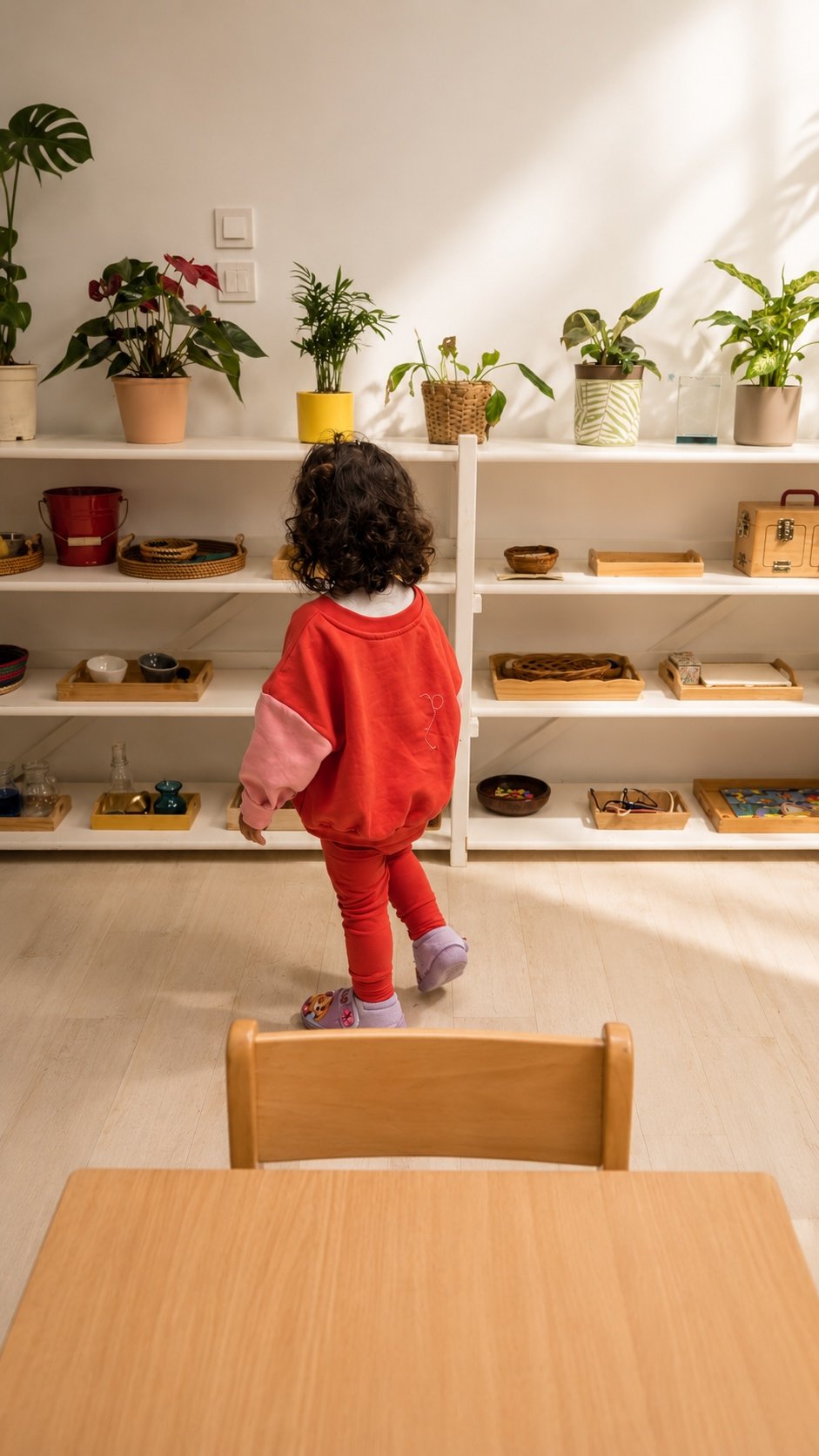
Order & landmarks
Provide security and guide the child in choosing activities.
Freedom of movement
The space allows free and autonomous movement.
Objects and furniture adapted to the child's size and strength
Objects and furniture adapted to the child's size and strength.
Aesthetics & care
A beautiful, well-kept place that helps the child engage in work.
The educator, a guide more than a teacher
At each age, your child has different developmental needs: the environment, teaching, materials and pedagogy must therefore be adapted.
« Help me to be by myself »
« Help me to do it myself »
« Help me to think for myself »
« Help me to be with others »
Montessori educators follow a dedicated training program for each age group, certified by the Association Montessori Internationale (AMI). These internationally recognized qualifications are identical worldwide for each age bracket.
of autonomous work to learn concentration
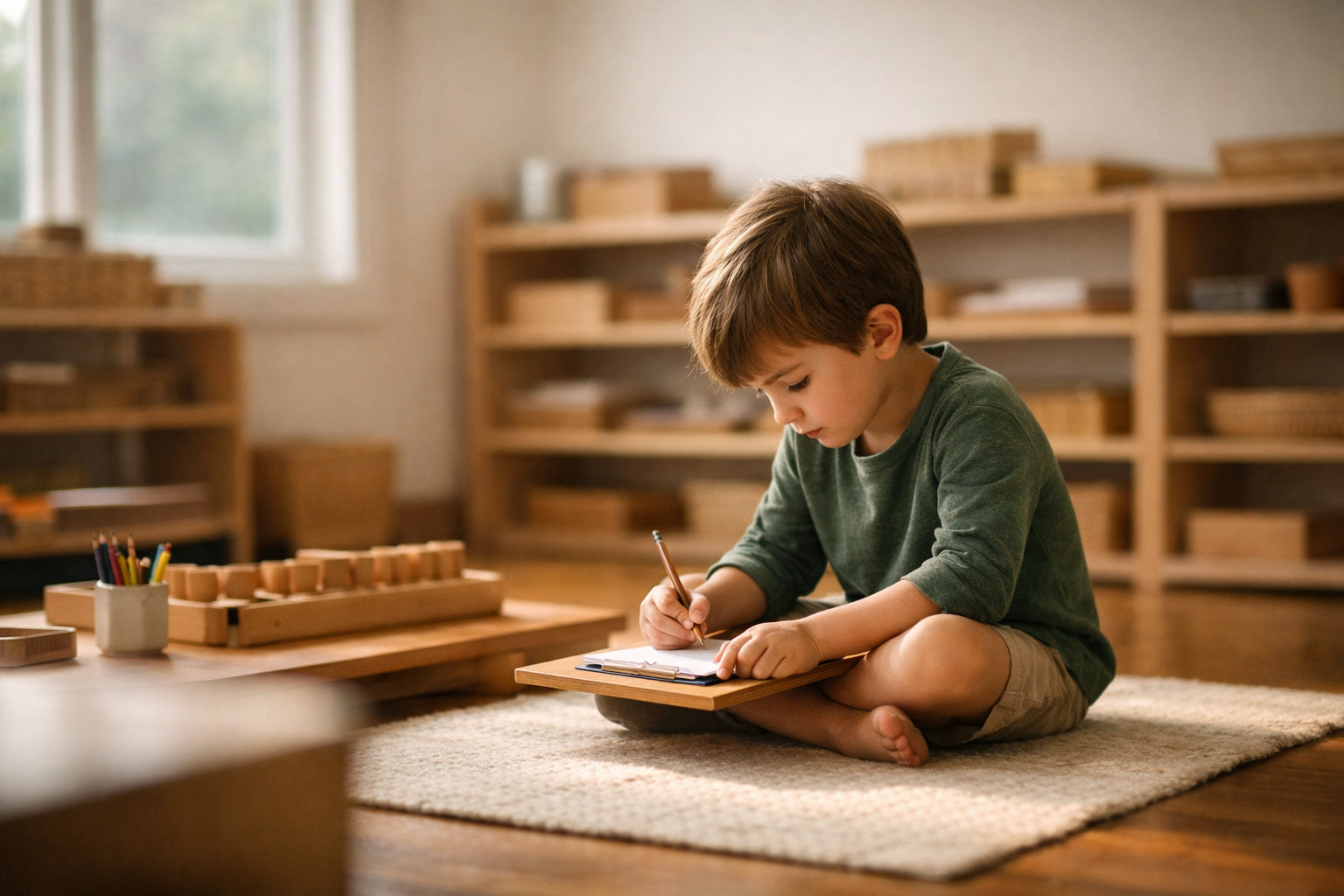
In a Montessori classroom, free choice of activity and individual concentration are encouraged each morning and afternoon through autonomous work periods of at least 2h30. During this time, your child chooses their activity and works on it, guided by the educators. By repeating the activity as many times as they deem necessary, your child learns concentration and durably acquires the fundamental concept addressed.
Bilingual education
We offer full immersion in French and English. In each classroom, two educators teach in both languages — one French-speaking, one English-speaking.
Discovering a second language at their own pace
Deepening the practice and the pleasure of communicating
From physical autonomy to psychological autonomy
The Colibris schools also prepare your child for acquiring psychological independence through:
Mathematical thinking
Logical thinking
Abstraction
Throughout the work done in our schools, your child moves towards a consciousness of their own will to advance towards independence. They are always guided by their sensitive periods, but the emergence of will — even before freedom — demonstrates the acquisition of growing autonomy.
Our commitments
Core Curriculum Recognition
Core curriculum skills validated and recognized
Ministry of Education Approved
School approved by the French Ministry of Education
AMI-certified educators
Internationally recognized training by the Association Montessori Internationale
Educational Pathways
Transitions possible to all educational pathways
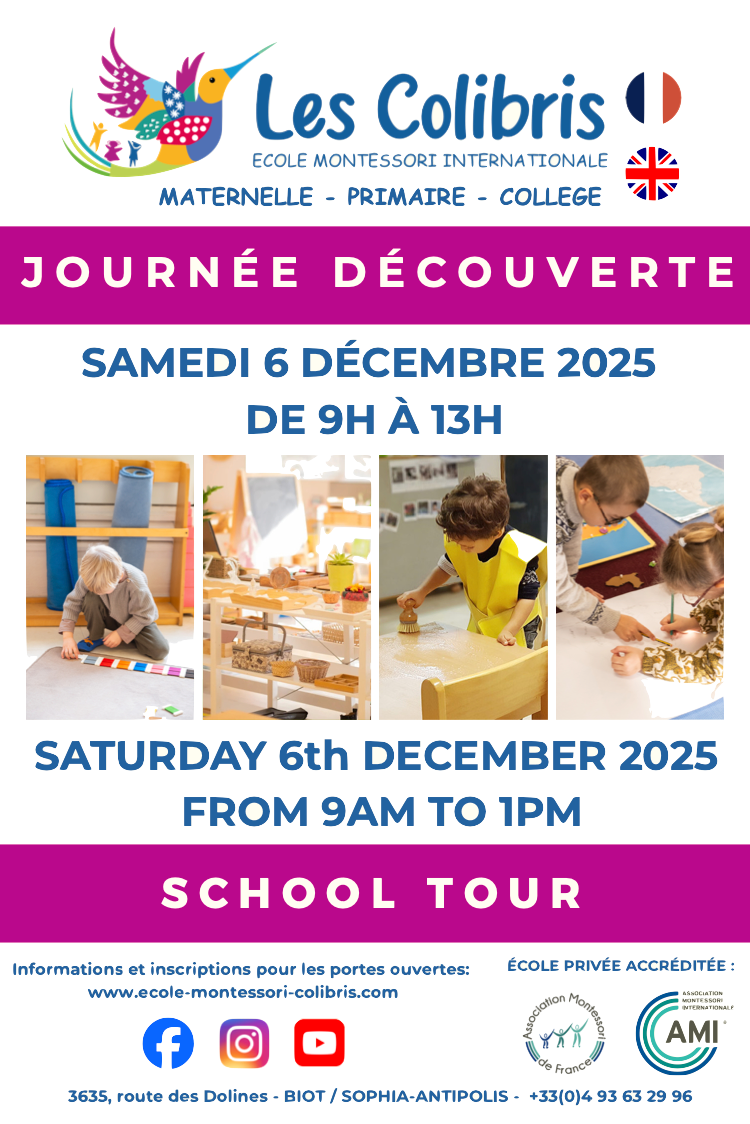
Discover Montessori pedagogy in action
Visit our schools and see how this approach transforms learning every day